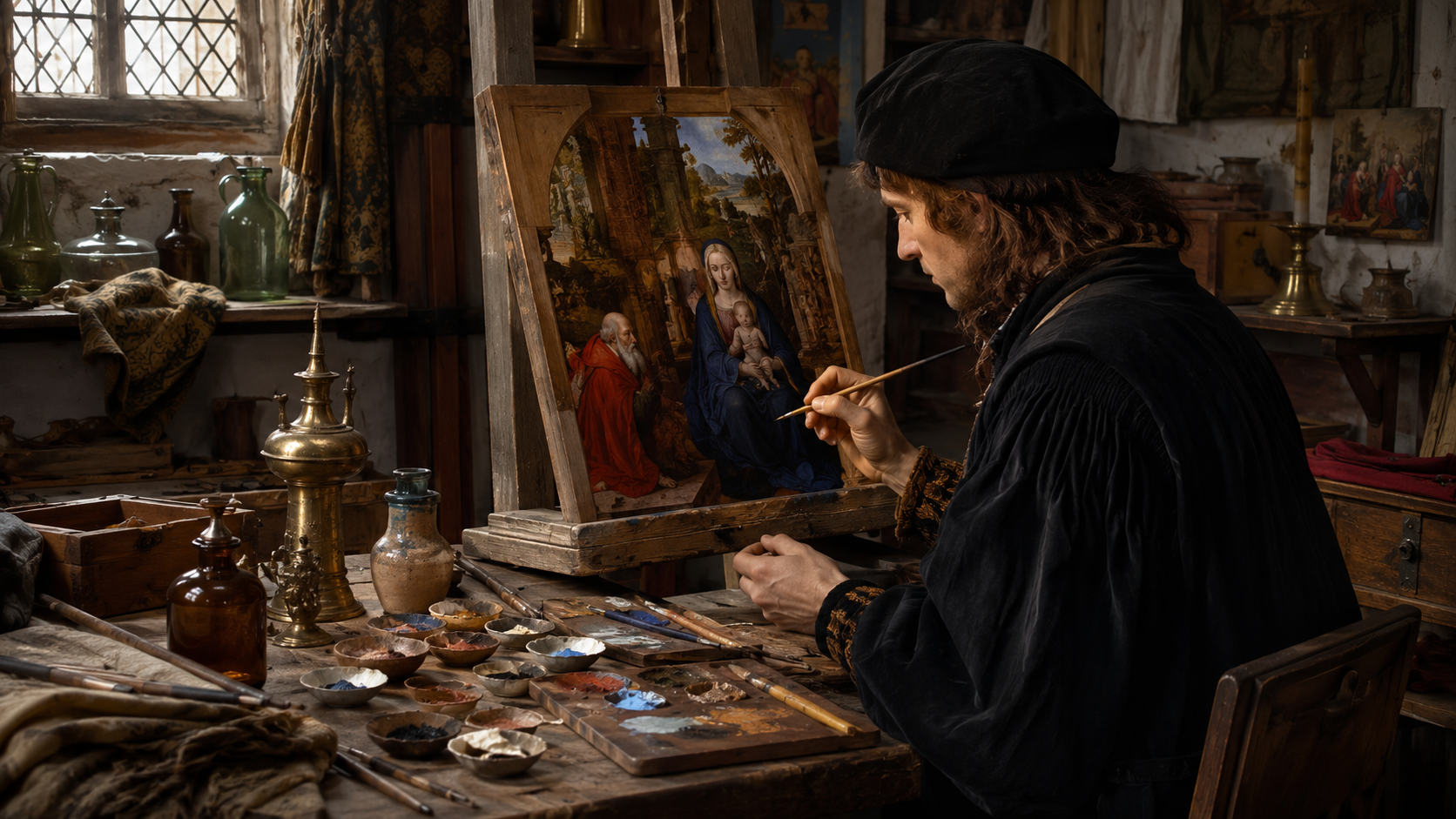
Some revolutions in art arrive with a manifesto and a bang. Others arrive quietly, in a workshop, as a slow change in the stuff smeared onto a wooden panel. The shift from tempera to oil paint in fifteenth-century Northern Europe was one of the quiet kind, yet it transformed Western art more profoundly than almost any movement that followed. It changed not only how paintings looked but what painting was capable of saying, and it gave the Northern Renaissance its unmistakable glow, that sense of jewel-like color and almost miraculous detail that still stops viewers in their tracks centuries later.
To understand why it mattered, you first have to understand what it replaced. For most of the medieval period, painters worked in tempera, pigment bound with egg yolk, usually on a wooden panel prepared with a chalky ground. Tempera could produce bright, clear, saturated color, and at its finest, in the work of early Renaissance Italians, it had a luminous, almost miniature-like beauty. But it had a stubborn limitation: it dried very fast. That rapid drying meant a painter could not blend one tone smoothly into another. Transitions between light and shadow tended to be abrupt, built up through fine hatching rather than seamless gradation. The other available option for large works, fresco, meant painting into wet plaster on a wall, a cumbersome process with a limited tonal range that had to be completed before the plaster dried. Both methods boxed the artist in.
Oil offered a way out, and the breakthrough is traditionally and famously credited to the Flemish master Jan van Eyck. It is one of art history’s most repeated stories, told first by the Italian biographer Giorgio Vasari, who hailed the discovery of oil color as a splendid invention and a great boon to painting. The truth is more nuanced, and worth getting right. Oil as a binder was not actually new; it had been described in technical treatises for centuries and used for humbler tasks like painting shields and carvings, where its water resistance made it more durable outdoors than tempera. Van Eyck did not invent oil paint from nothing. What he and his fellow early Netherlandish painters did was something subtler and arguably more important: they made oil the primary medium for serious art and discovered the techniques that unlocked its full expressive power.
The technical advantages, once mastered, were transformative. Because oil dries slowly, the painter suddenly had time, the freedom to blend colors directly on the panel, to work wet paint into wet paint, and to achieve the soft, imperceptible transitions between tones that tempera could never allow. The colors themselves were deeper and richer, and the dried surface had a smooth, durable, faintly luminous quality. Van Eyck reportedly experimented with different oils and found that linseed and walnut oils dried faster and bound his pigments so vibrantly that the finished work needed no final varnish, and was waterproof besides.
The single most consequential technique to emerge was glazing. Rather than mixing an opaque color and laying it down in one pass, the oil painter could apply many thin, almost transparent layers of color, one over another, each allowed to dry before the next. Beneath them sat a pale, often white ground. Light from outside the painting would pass down through these translucent glazes, reflect off the bright ground beneath, and travel back up to the viewer’s eye, glowing as if lit from within. This is the secret behind the extraordinary radiance of Northern Renaissance painting, the reason a van Eyck altarpiece seems to emit light rather than merely reflect it. Combined with oil’s capacity for minute detail, glazing let painters render the world with stunning naturalism: the gleam of metal, the weave of fabric, the soft fall of light across a face, individual hairs and distant reflections captured with a precision that astonished contemporaries.
The masterpieces this produced defined an era. Van Eyck’s monumental Ghent Altarpiece and his famous double portrait of a couple in a richly furnished interior showcased a new kind of picture, dense with texture, depth, and lifelike presence. Fellow Netherlandish masters like Robert Campin, Rogier van der Weyden, Hans Memling, and Hugo van der Goes pushed the medium further, building a tradition of meticulous, glowing realism that became the signature of Northern art.
Such results could not stay confined to one corner of Europe. The new technique, and the spectacular paintings made with it, traveled south across the Alps and reshaped Italian art too. The figure most associated with this transmission is the Sicilian painter Antonello da Messina, whom Vasari credited with carrying van Eyck’s secret method back to Italy. Modern scholars treat that tidy story with caution; Antonello more likely absorbed the technique from Flemish paintings that reached Naples and Sicily through trade, rather than from a personal pilgrimage north. Either way, his achievement was real: he mastered the Flemish oil method, applied glazing to achieve a new psychological depth in his portraits, and helped spread the medium within Italy, especially in Venice, where artists proved among the first Italians to embrace it fully. From there the medium’s progress was unstoppable. Leonardo perfected sfumato, the smoke-like blurring of edges that oil made possible, and Venetian painters like Bellini and Titian eventually pushed it toward visible, expressive brushwork. Within a few generations, tempera as a primary medium for panel painting had become all but extinct.
What makes this story so compelling is that it shows how a change in materials can change the very possibilities of an art form. The slow-drying, light-catching nature of oil did not just give artists a better tool; it gave them new things to attempt, new realism to chase, new emotional subtleties to capture. The glowing portraits and luminous altarpieces of the Northern Renaissance were not simply the product of genius. They were the product of genius meeting exactly the right medium at exactly the right moment, and discovering, layer by translucent layer, that paint could finally hold light.